
Plain English
Built for living.
What do all these kitchen remodeling terms mean?
Remodeling quotes are full of terms that decide real money — the difference between quartz and quartzite, framed and frameless, semi-custom and custom changes what you pay and what you get. The glossary below defines the vocabulary in plain English, grouped by cabinets, countertops, and process, so you can read any bid — ours included — without a translator.
Last updated:
Cabinets
- Shaker
- A door style with a flat center panel inside a squared frame — the most common look in American kitchens because it reads both classic and modern.
- Flat-panel (slab)
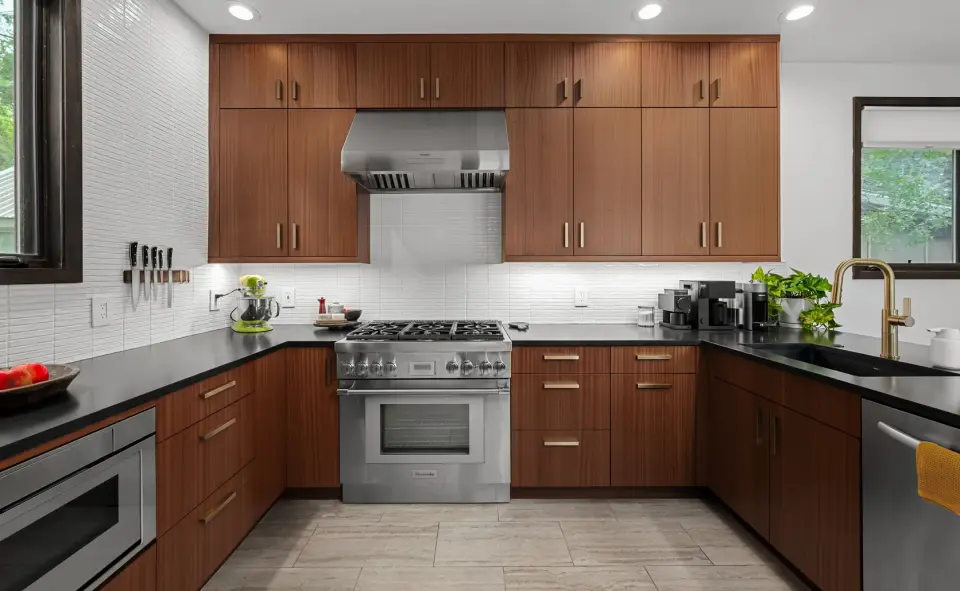
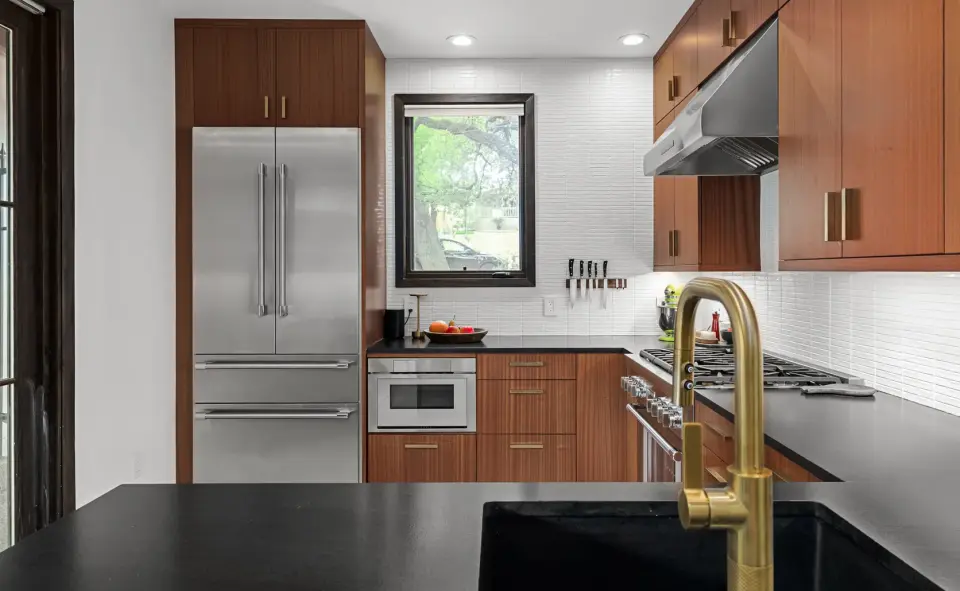
- A completely flat door with no frame or profile; the foundation of modern and mid-century kitchens.
- Framed construction
- Cabinet boxes with a face frame around the opening; doors mount to the frame. Traditional American construction.
- Frameless (full-access)
- European-style boxes with no face frame — doors mount directly to the box sides, giving wider openings and a seamless front.
- Stock cabinets
- Factory-made cabinets in fixed sizes and finishes. Fastest and most budget-predictable tier; design skill lies in planning the runs.
- Semi-custom cabinets
- Standard lines that allow real changes — sizes, finishes, storage upgrades. The middle tier; Cabinet IQ installs Bellmont among these lines.
- Custom cabinets
- Built to the kitchen’s exact dimensions and design rather than chosen from a catalog. Cabinet IQ’s custom tier is its Signature Line.
- Dovetail drawer
- A drawer box joined with interlocking fan-shaped cuts — a durability marker worth looking for when comparing construction quality.
- Soft-close
- Hinges and drawer glides that catch and slow the last inch of travel so nothing slams.
- Appliance garage
- A cabinet section that hides small appliances — coffee maker, mixer — behind a door at counter level, keeping the counter clear.
- Toe kick
- The recessed space at the bottom of base cabinets that lets you stand close to the counter.
- Filler strip
- A finished strip that closes small gaps between cabinets and walls; how standard sizes get fitted to non-standard rooms.
Countertops
- Quartz
- An engineered stone surface: consistent patterns, non-porous, never needs sealing. Not the same thing as quartzite.
- Quartzite
- A natural quarried stone with marble-like veining and near-granite hardness. Needs periodic sealing; every slab is unique.
- Porcelain (sintered stone)
- Mineral surfacing compacted and fired at extreme heat: non-porous, highly heat- and UV-resistant, viable even outdoors.
- Templating
- Precise measurement of the installed cabinets — usually by laser — used to fabricate the countertop. Happens after cabinets are set; accuracy here decides how the stone fits.
- Seam
- Where two pieces of countertop meet. Seam placement is planned around sightlines and slab sizes; fewer and better-placed seams are a fabrication-quality marker.
- Edge profile
- The shape of the countertop’s finished edge — eased, beveled, rounded, or more detailed. Chosen with the door style so cabinet and counter read as one design.
- Waterfall edge
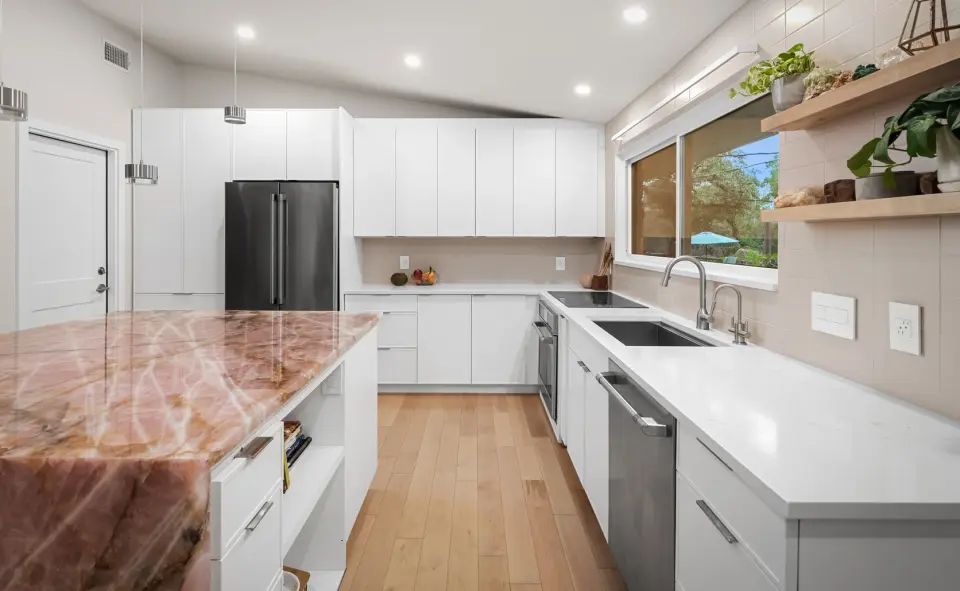
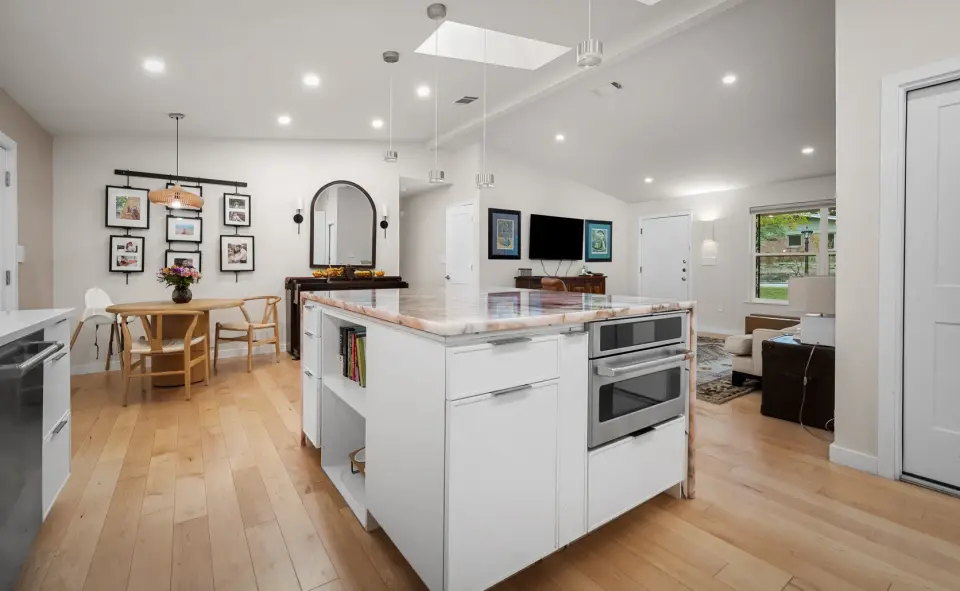
- Countertop material continuing vertically down the side of an island to the floor — a statement detail in several Cabinet IQ gallery projects.
- Cutout
- An opening fabricated in the counter for a sink, cooktop, or outlet. Each adds fabrication work and is priced into the quote.
Process & paperwork
- Design lock
- The moment layout, cabinetry, countertops, and finishes are final and ordering begins. Cabinet IQ’s published guideline runs 8–16 weeks from design lock to final install, depending on scope.
- Work triangle
- The classic layout principle connecting sink, stove, and refrigerator; modern planning often thinks in work zones instead, but the goal — short, unobstructed paths — is the same.
- Scope document
- The written list of exactly what a quote includes: products, finishes, labor, demolition, disposal. The only fair way to compare two bids.
- Punch list
- The closing checklist of small items — adjustments, touch-ups — completed between substantial finish and final walkthrough.
- ROC license
- Arizona’s contractor license, issued by the Registrar of Contractors. Any homeowner can verify any contractor’s license status and complaint history at azroc.gov.
- Milestone payments
- A payment schedule tied to project stages rather than paid up front — the structure reputable remodelers use.
FAQs
What is the single most misunderstood term?
Quartz versus quartzite. Quartz is an engineered surface that never needs sealing; quartzite is a natural quarried stone with marble-like veining that does. They sit next to each other in showrooms and behave completely differently at home.
What does semi-custom actually get me over stock?
Meaningful size adjustments, a wider curated range of doors, finishes, and storage upgrades — without full-custom lead times. It is the middle tier Cabinet IQ installs most for complete remodels, including Bellmont lines.
Which terms should I check on any quote?
The cabinet construction terms (framed or frameless, dovetail drawers, soft-close), the countertop fabrication terms (templating, seams, edge profile, cutouts), and the accountability terms — who is the licensed ROC contractor on the job. If a quote can’t define its own terms, that is the finding.
Book a free kitchen consultation
No cost, no obligation — start by phone or at the Tatum Blvd showroom.